
An Introduction to the Practice, Philosophy and Art of Awareness
Student: Master, what is Ly Qigong?
Master:
Ly Qigong is a practice that uses movement, stillness, breathing and awareness to help us become more present with ourselves and the world around us.
But to understand Ly Qigong, we must first look beyond the physical movements.
Many people approach Qigong believing that its purpose is simply to learn a series of movements, improve flexibility, develop balance or cultivate physical and mental wellbeing.
Although these may be valuable aspects of the practice, they are not the entirety of what we are exploring.
Ly Qigong is, fundamentally, a practice of awareness.
It invites us to become more conscious of how we move, how we think, how we feel and how we respond to the experiences of everyday life.
It encourages us to develop a closer relationship with ourselves, not by attempting to become someone else, but by becoming more present with who we are.
But Master, How Do We Practise Awareness?
We begin by learning to become present.
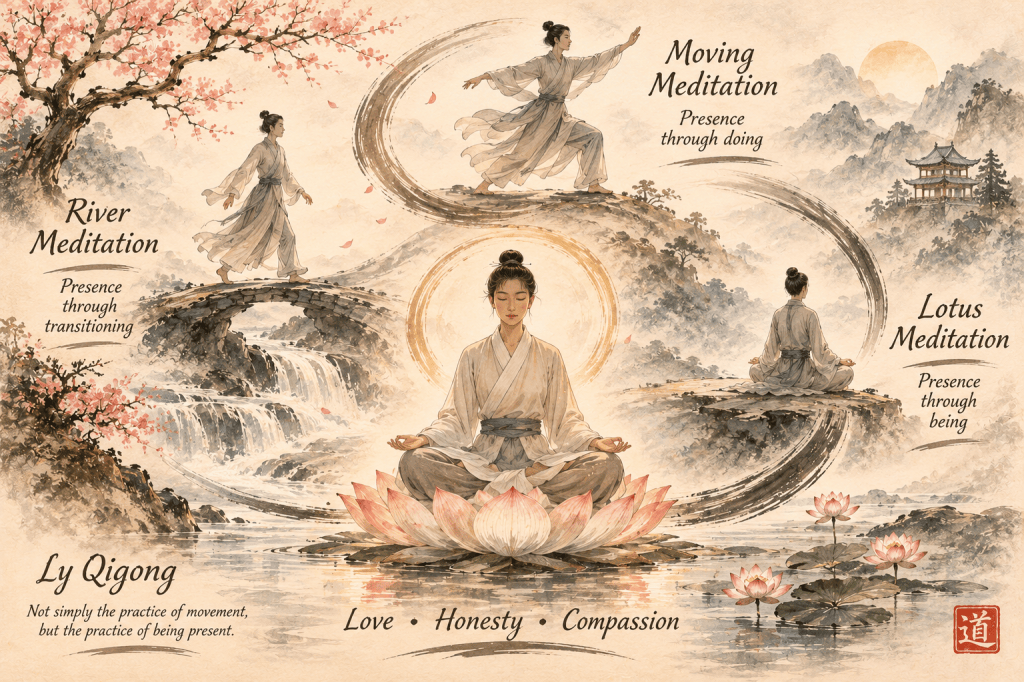
In Ly Qigong, we recognise three expressions of meditation:
1. Moving Meditation
We practise becoming present through movement and everyday activities.
When we perform Qigong with awareness, our movements become more than physical exercises.
We become attentive to our bodies, breathing, sensations and surroundings.
And this awareness need not end when we leave our practice space. Walking, working, listening and performing everyday tasks can all become opportunities to practise presence.
2. River Meditation
We practise becoming present through transitions.
Life is constantly moving from one experience to another. We move between places, conversations, emotions, responsibilities and circumstances.
River Meditation encourages us to flow through these transitions without unnecessary resistance, attachment or emotional tethering.
We learn to acknowledge what has happened without becoming imprisoned by it, and to meet what comes next without becoming consumed by anticipation.
Like a river, we allow life to move whilst remaining present within its movement.
3. Lotus Meditation
We practise becoming present through stillness.
By sitting quietly and resting in awareness, we give ourselves the opportunity to experience the present moment without constantly pursuing, resisting or grasping.
We do not need to force the mind into silence or demand that every thought disappear.
We simply practise being present with whatever arises.
These three expressions are not separate destinations. They are different opportunities to cultivate the same quality of awareness.
But Master, What Makes Ly Qigong Different?
The distinction lies in the intention behind the practice.
We are not simply trying to become better at performing movements.
We are exploring how the awareness cultivated through those movements can influence the way we live.
For example:
Can you remain present when someone disagrees with you?
Can you recognise an emotion without immediately reacting to it?
Can you listen to another person without preparing your response before they have finished speaking?
Can you experience a difficult situation without allowing it to consume your entire sense of being?
Can you recognise when you are holding on to something that no longer serves you?
These are also opportunities to practise.
The practice becomes meaningful when what we cultivate during Qigong begins to influence how we meet ourselves, other people and the world.
The Three Guiding Principles
Throughout Ly Qigong, we use three fundamental principles as our compass:
LOVE
Learn to meet yourself and others with Love. Allow Love to influence the way you treat yourself, how you interact with others and how you experience life.
HONESTY
Be honest with yourself. Recognise what is present rather than what you wish were present. Awareness requires the willingness to see things as they are, including those things we may find uncomfortable.
COMPASSION
Practise meeting yourself and others with patience, understanding and Compassion. Recognise that everyone is navigating their own experiences, limitations and opportunities for growth.
Love, Honesty and Compassion are not merely words to memorise. They are principles to explore and embody through practice.
They become our compass when navigating the complexities of everyday life.
But Master, Do I Need to Be Good at Qigong to Benefit From It?
No.
You do not need to be flexible, particularly strong, experienced or naturally talented.
You do not need to compete with another practitioner or measure your progress against someone else’s.
Come with patience, humility and a willingness to explore.
There is no need to rush towards becoming an advanced practitioner whilst overlooking the opportunity to become more present as a beginner.
Sometimes, the greatest progress is not found in performing a more complicated movement, but in becoming more aware of a movement you have performed hundreds of times.
Allow yourself to learn.
Allow yourself to make mistakes.
Allow yourself to discover.
One Final Teaching
Do not mistake Ly Qigong for something that only happens during a class.
Your practice begins when you become aware of yourself and continues through the way you choose to experience life.
When you move, practise awareness.
When you transition, practise awareness.
When you sit in stillness, practise awareness.
When you encounter difficulty, practise awareness.
And when you forget to be present, recognise that too. There is another opportunity to return.
Remember, the objective is not to become a perfect practitioner.
It is to become more present with the experience of being alive.
Ly Qigong is not simply about learning how to move the body. It is about discovering how awareness can move through every aspect of our lives.
The movements are an invitation.
The meditation is the practice.
Love, Honesty and Compassion are the compass.
And life itself becomes the opportunity.
Ly Qigong: Not simply the practice of movement, but the practice of being present.

